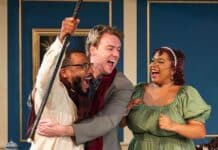
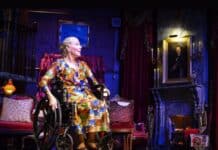
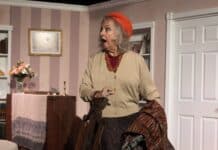
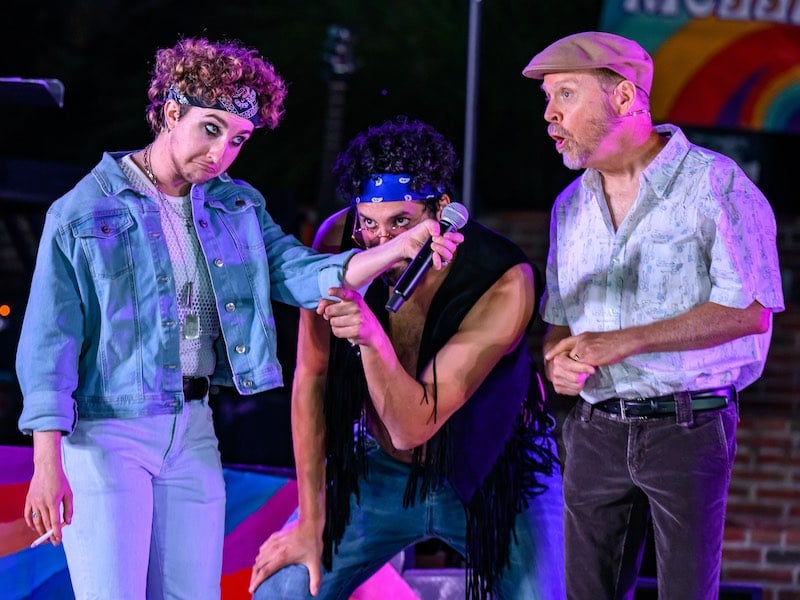
The City of Fairfax Theatre Company’s outdoor production of Much Ado About Nothing sets Shakespeare’s arguably best-loved romcom behind the scenes of a 1975 music festival. We’re talking bellbottoms, fringe vests, and haze from indeterminate sources. The play’s plot is framed as the goings-on behind the scenes of the concert that’s taking place as the musicians finish a tour, as opposed to returning from war, though many musicians would likely not see the distinction.
Director Olivia Hinebaugh’s program note expresses the immense meaning to her of this staging: Her parents met at a “small bluegrass festival” in 1974, and they are nearing their 50th anniversary; however, her father will soon pass away from glioblastoma. As Hinebaugh writes, “My life with him has been punctuated with music of the ’70s. Listening to The Who together is a central memory when I think back on my life with him as a dad. My mom shares memories of putting on mascara and listening to records while she looks forward to driving down to meet my father in a college across the state. Their song was ‘Your Song’ by Elton John, and that is imprinted on my heart.”
You can’t argue in good faith against a premise so important to its auteur. It doesn’t particularly matter if the context “works,” or whether the play presents a “new conversation” about Shakespeare. Let people tell stories. Let them have their catharsis. Even my mom, who prides herself on being a Roger Scruton enjoyer and Western Civilization appreciator, agreed upon seeing this production with me last night. What’s the goal of analysis? Finding meaning and fulfillment. This production has created that for its director. And I’m sure others in the audience and perhaps the cast find themselves in her position.
Does turning Much Ado’s characters into a group of bandmates at a ’70s Woodstock-y music festival work? I’m not sure. I think it’s easy to look at the play’s classic iconography — see Kenneth Branaugh and Emma Thompson running around in a sun-soaked field — and walk away with the idea that this is essentially Mamma Mia, and everyone’s having a great time. It’s easy to forget that over the course of this play, Claudio’s heart breaks, a father disowns his daughter, and most crucially, extramarital sex is utterly condemnable.
Regardless of how you come down on issues of sexual politics and morality, there is a dissonance between the sexual values of the Much Ado story and those of countercultural beatniks from the sexual revolution. Shakespeare’s script includes mentions of upholding a woman’s “virginity” and “maidenhood” — to see those sexual politics revealed in the words of a group of people who we see have dramatically different beliefs is jarring.
This isn’t just about generalized impressions about the ’70s or what was going on at Woodstock or the values of hippies — this is about what we see playing out on stage. To have Don Pedro openly inviting multiple women into romantic relations simultaneously — as well as men, as we see through brief modern-vernacular additions to the script — and then to have his dear friend Claudio call Hero upon hearing of her possible sexual encounter with another man an “approved wanton” and one of “those pampered animals that rage in savage sensuality” simply does not gel. Infidelity is one thing and “free love” among consenting adults is another, but if Claudio holds the values of his bandmates not merely as the cultural lexicon has illustrated the ’70s but as we see them portrayed on stage, he would almost certainly not speak in these terms.
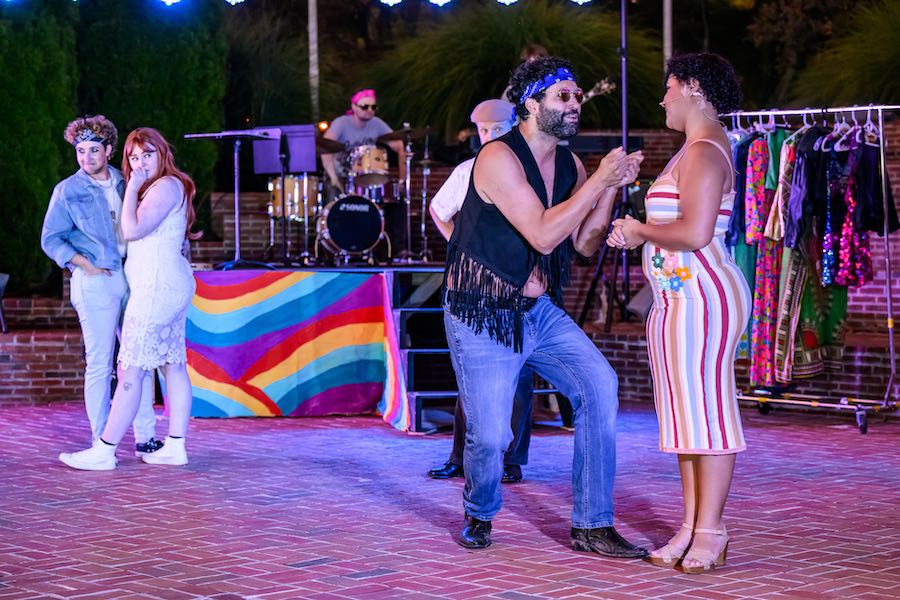
I wondered if perhaps the director of this production is trying to say something about the hippie movement — perhaps something about how it wasn’t as sexually raucous as many may think — but we literally see that permissiveness, not only brought out of the script through phallic gesturing and hip thrusts at moments but in additions to the script. On top of some of the lines mentioned above, Don Pedro calls Hero and Claudio “horndogs” more than once.
Oh, and Leonato and the male Friar Francis are married in this production, through the addition of the word “husband” to lines from both of them — I doubt that people this concerned about female maidenhood and virginity in the eyes of God are okay with gay people. Even if these two characters are performed with chaste demureness of character, their mere orientation would come into conflict with the family of sexual values reflected in Shakespeare’s text.
Shakespeare’s original Much Ado characters were, in fact, inconsistent in the way they walked the talk of their sexual beliefs to at least a small degree. Those double entendres are in the script — as they are in so much of Shakespeare’s work — and these were originally soldiers returning from war, after all — soldiers are not known for their demurity of tongue. But making a genitalia joke and actually going through with intercourse are still very different things.
And is the setting of the sexual revolution trying to say something about a generation’s changing values during a rebellious time? Perhaps it’s pointing out that some of these hippies wouldn’t practice what they preach? That would work as a point of analysis if the play didn’t still end with the philanderer being cast out and Hero and her family devastatingly grateful to have her “virtue” restored in the eyes of God.
Michael Santos Sandoval is a fantastic Benedick, acting with sophistication and lovable wit that are believably shanked by the news that someone’s in love with him. Victoria Jungck is an ideal Beatrice and especially stands out for her formidable acting in the “O that I were a man!” speech. Gerardo Mijares-Shafai gives a lovable performance in the cast as a Don Pedro who is a joker but an ally to his friends when needed — which makes sense, given that his full title is indeed Don Pedro, Prince of Aragon. Don Pedro must connect with the audience through humor and sincerity, and Mijares-Shafai fulfills the role wonderfully. Mia Shaker utterly brings down the house as Dogberry, the excitable guard whom you’d better not call an ass, or else he’ll bounce up and down and be very upset while making you belly-laugh in the process.
The costume selections in this performance as designed by Angela Lee are spot-on: Benedick and Beatrice, who carry themselves with a bit more sophistication than their peers, are dressed with a bit more polish and a bit brighter color than their bandmates, helping them stick out as the protagonists.
I saw this performance on opening night and there were some mic issues — at least one of the watchmen did not have a working mic, and there were several moments during which mics were scruffed or bumped by all the fur and leather — but in an outdoor venue where grunge is the name of the thematic game, it didn’t take away much.
I’m so glad that someone is doing Shakespeare in Fairfax, and there’s nothing more fascinating than seeing a new interpretation of a familiar text. What was I not thinking about before? I hope all who go to see this production bring their own perspectives to the table.
Running Time: Two and a half hours with one 15-minute intermission..
Much Ado About Nothing plays through September 15, 2024, presented by City of Fairfax Theatre Company performing at Veterans Amphitheater, 10485-10489 Armstrong Street, Fairfax, VA. Purchase ticket (adult, $27.25; students and aged 12 and under, $16.75) online.
The program for Much Ado About Nothing is online here.
COVID Safety: Masks optional. Note that the performance takes place outdoors, and you must bring your own chairs (only a few are available). As a result, you can sit anywhere at a social distance of your choosing.