i. basic
The first time I encountered what I call a “theater bro,” it was in my first semester of college.
It was September 2017. I was attending Wesleyan University, a small liberal arts school in Middletown, Connecticut — it’s a college that carries prestige for people who actually know that it exists. As I nervously went through my first week of classes, in every cafeteria conversation, it felt like I was being interviewed to see if I’d be a good friend or collaborator. It was the year after Hamilton swept the Tonys, and the musical’s creator, Lin-Manuel Miranda, had just become the university’s most famous alumnus. Every student at Wesleyan, even if we didn’t admit it, believed we could also make it big through our art.

Walking around campus, I had a serious case of imposter syndrome. Somehow, I’d schemed my way into a world where every guy was experimental, edgy, and cool. I could only pass as one of them. Back in my Virginian private school, I was surrounded by more traditional “bros”: guys who told crass jokes, got lacrosse scholarships, and sported dirty Nike socks and ratty mullets. Up at Wesleyan, I was surrounded by a new artsy kind of bro: guys who gave you unprompted fun facts about the film Whiplash, complained about Middletown being too rural compared to Manhattan, and donned so many beanies to the point of parody.
One evening I was hanging out in the common room of Butterfields: a dank, winding dorm colloquially referred to as the “Butts.” A lanky guy struck up a conversation with me, and I mentioned that I was in a class called “Award-Winning Playwrights.” When the guy asked me what my favorite play was, I froze. Before this class, I’d only read Shakespeare and Tennessee Williams; I didn’t have an idiosyncratic answer to offer. The first play assigned in my class was Angels in America, so I blurted that out.
“Basic choice, but a classic,” he responded. He then gave a long anecdote on Annie Baker: how he’d performed her observational but profound plays, and how I should really read them. I nodded along, trying to hide the sting of humiliation. Back in Virginia, I was eccentric compared to the bros. But here, I was “basic” compared to them. I needed to study more plays so that I could prove myself as belonging with the theater in-crowd.
I soon became friends with this lanky guy. But for years, I resented him for being so dismissive in our first conversation, for making me feel so small. It wasn’t until recently that I realized he was trying to prove himself to me. At the time, he was insecure, too.
ii. good person
Jane — the protagonist of the Max Von Friedlich play Job, now running at Arlington’s Signature Theatre — also resents the people from her college. She’s in one of the most intense hours of her life, holding her work-assigned therapist hostage. Yet she’s still drawn to mocking her alma mater, and the virtue-signalling Instagram posts that flooded that kind of world. Her terrified therapist asks if she’d ever publicly share those thoughts, but Jane rejects the premise.
“I don’t own it though,” she says about herself. “I’d never put that out there. I’d get ripped apart… On like Twitter or Instagram. Like people I went to college with would explode at me.”
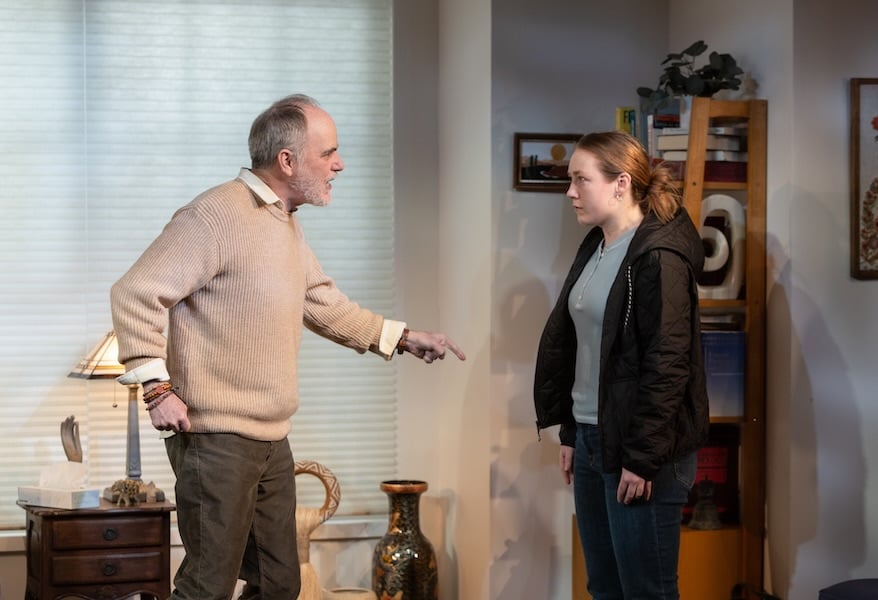
Explosions — psychological, physical, and societal — keep happening for Jane, with no relief in sight. Over the course of an extreme 90 minutes, Jane holds her therapist captive, alternately arguing, pleading, threatening, and opening up to him. The dialogue feels startlingly familiar to the words I’ve spoken to my own friends, in college and beyond. Seeing Job, I felt uncomfortably similar to Jane. This may be because Friedlich and I have similar experiences. He graduated from Wesleyan in the spring of 2017; we missed sharing the campus by one semester.
Job opens with Jane (Jordan Slattery) wielding a gun toward a therapist, Loyd (Eric Hissom). Loyd soon convinces Jane to put down her gun, and she apologizes profusely, placing her weapon gingerly into her Trader Joe’s tote bag. Still, she won’t let Loyd leave the room — she’s come to his office to get approval to return to work, and she won’t leave without it.
The rest of the play functions as a tense standoff. Working professionally and defensively, Loyd starts asking questions about Jane’s upbringing and career. With much reservation, Jane shares that she was working as an online content moderator at a technology company until she had a mental breakdown. An incident of her screaming went viral, and she was placed on paid leave, despite desperate attempts to return to work.
Throughout their conversation, Jane constantly pushes back on Loyd’s therapy-speak, and starts grilling him on his own life. Loyd is a Berkeley graduate working in downtown San Francisco, a folksy type who’s cautious about technology and avid about his teenage children. The clash between the two characters becomes generational. Jane is rebuking the liberal world she’s inheriting from Loyd. Loyd is defending that world while wielding more institutional power than Jane.
Watching Job at Signature Theatre, I saw a similar generational clash happening in the audience. Job was originally staged in two off-Broadway venues, before a 14-week Broadway run in 2024. The play gained greater notoriety after a TikTok video praised the show’s writing and direction, which then spurred a group of trendy, young New Yorkers to watch the show.
These New York audiences probably aligned themselves politically and generationally with Jane. But much of the Virginia audience, composed of middle-aged regional theater subscribers, probably aligned themselves at the start of the play with Loyd. There were a few times at the performance I attended where I was the only one laughing at Jane’s snarky jokes — specifically when she calls herself a “Xanax girlie” and admits that all of her college friends “were literally socialists.” Maybe I only laughed at these jokes because I’m Gen Z. Maybe I’m just fluent in Jane’s brainrot culture, which isn’t as popular in DC.
Even as Jane and Loyd’s conversation twists in unexpected directions, Jane keeps bringing up her time in college. It’s like a rash in her memory, one that she can’t stop scratching. She calls her college friends “cringey rich assholes.” She remembers a toxic college relationship, which had abundant sex but limited intimacy. Jane even rails against her school’s aesthetic:
JANE: …Literally all I can remember about the first semester of college was trying to figure out how to dress like I cared about social justice and the cafeteria workers’ union and gender-netural bathrooms. To give a shit I had to smell like shit – I had to wear ratty t-shirts to be publicly accepted as a good person.
LOYD: Did you enjoy college?
JANE: Loved it.
In these lines, I hear echoes of my experiences with theater bros. I applied for early decision to Wesleyan because of its collaborative environment (as opposed to the cutthroat Ivy League). But when I arrived on campus, it was jarring to face new pressures. Every student seemed to compete for status as the most socially conscious, the most radical, the most controversial. In the face of this, many Wesleyan students found a subversive pleasure in being “normie.” In an academic world where everyone strove to be avant-garde, many resisted by behaving as mainstream as possible. I’ll admit, I felt oddly disruptive if I wore a polo shirt to a class.
The desire for mainstream appeal was shared by the university administration. In the wake of the 2016 election, Wesleyan University President Michael Roth promoted what he called “intellectual diversity” and the expansion of student athletics. “Athletes on campus have different perspectives from the avant-garde surrealist pop guitar player from Park Slope,” Roth said in a Slate article published during my first semester. “You can’t be a caricature of yourself,” he continued.
Even if my college has a caricatured reputation as activist and abrasive, it’s an energy that I love (like Job’s Jane). At its best, the university felt like a refuge, where gays and artists could gather away from our stifling hometowns. But also like Jane, I knew this refuge was an illusion. A few students had families that gave them immense power on campus and beyond. Their last names appeared in film credits and Broadway playbills and on the sides of buildings. In Job, Jane also arrives at this bitter realization: “But one day it just sort of hit me – I was nothing like them. / I didn’t have an uncle who could get me a job on a TV show.”
I felt relief hearing this line, hearing unspoken privileges finally named. But I also knew these words were coming from a character that was jaded and violent. Was Friedlich asking the audience to understand someone like me, even if I was rendered delusional? And did Friedlich write these words as a self-critique?
iii. boygenius
Like many Wesleyan students, Friedlich grew up in New York City and was introduced to the arts at a young age. He grew up going to a live-action roleplaying summer camp, and in high school, he wrote a play called SleepOver. After studying American studies at Wesleyan, he continued producing his own work, briefly wrote for television, and joined playwriting programs. Friedlich was inspired to write Job partially through two experiences: speaking to an overworked content moderator and helping run accounts for the fictional influencer Lil Miquela.
On one hand, Friedlich himself is the epitome of the “theater bro” that Jane and I resent: a Manhattan socialite who had industry advantages before stepping on a college campus. Just look at how Wesleyan University Magazine tells Friedlich’s story. A feature on him is very specific about the ways he’s had a “D.I.Y. approach” to theater, like raising $10,000 through Kickstarter. But when discussing his family’s career influence, the article suddenly turns vague: “His parents… have supported his artistic aspirations and helped him make connections along the way.” I wish I had parents who could make connections like that.
On the other hand, Freidlich’s upbringing isn’t that different from my own. I’m pretty much the DC equivalent of a Manhattan socialite: I went to an expensive private school, never had to worry about financial independence until the age of 18, and did read Shakespeare before college. I’ve benefited from all of the systems I’m calling out.
Maybe I’m angry that, even with my vast privileges, there are people like Friedlich with even greater privileges. Maybe I don’t hate Max Wolf Friedlich as much as I want to be him. Maybe my resentment for him comes from a sublimated envy. Part of this envy comes from knowing Friedlich’s career path is impossible for me to follow. When Friedlich graduated college in 2017, he could explore the theater industry and develop Job in small venues like the Connelly Theater. When I graduated college in 2021, I found a theater industry limping from the pandemic, with even fewer entry points. No one’s producing plays at the Connelly nowadays.
In another world, I’d love to read the script of Job blindly, not knowing the writer’s age or background. But theater doesn’t exist in a vacuum, and Friedlich’s status as a boygenius wunderkind allows Job to be produced. There are writers similar to Friedlich who also explore the disaster of the Internet. Watching Job, I’m reminded of the chronically online characters satirized by Patricia Lockwood, Tony Tulathimutte, and Honor Levy. What distinguishes Friedlich from his colleagues, and what catapults him into fame, is his role as a dramatist. He’s highly attuned to the audiences hearing his words and writes for them. In a profile for Vulture, Friedlich shared his pride that Job was attracting niche subcultures: “We’re a hit among teenagers; we’re a hit among NYU people and Dimes Square motherfuckers.”
As Friedlich navigates an increasingly commercial career, he’s drawn further from these subcultures. I know about the Dimes Square scene out of morbid curiosity, but most people watching Job in Virginia don’t. In that same Vulture profile, Friedlich acknowledged his capitalist impulses, saying “half-jokingly” that he’s making “theater for boys.” He stated: “If the industry is going to survive, we need 30-year-old bros to get onboard thinking this is a cool thing.”
I see Friedlich’s concept of “theater for boys” as similar to Michael Roth’s concept of “intellectual diversity.” Both are trying to welcome a male demographic into a space where they’ve previously felt sidelined. I’m sympathetic to this mission, but when I hear “theater for boys,” my first instinct is to roll my eyes. I mean, come on. Thirty-year-old bros already run Silicon Valley and Hollywood and the government — they don’t need more space, especially in one of the few industries where marginalized people work consistently. We don’t need affirmative action for white guys. Of course, Friedlich, catering to a bro crowd, can make it to Broadway early in his career. Meanwhile Paula Vogel, writing mostly about queer women, had to wait decades for the same career honor. This double standard isn’t Friedlich’s fault, but it’s an advantage for him.
Whether we like it or not, the U.S. government is creating a new era of “theater for boys,” particularly in DC. The National Endowment for the Arts is eliminating any funding for works that support diversity, equity, and inclusion. It’s also introduced “gender ideology” restrictions on funding. Lin-Manuel Miranda recently pulled Hamilton out of the biggest performing arts organization in DC, and its new leadership responded by saying, “Hamilton can’t perform for Republicans” and “Stop the intolerance.”
The two worlds I anxiously navigated as a teenager (conservative Virginia bros and artsy Wesleyan bros) are colliding at an alarming pace. I feel like I’m going insane. If the current political administration had its way, there would only be theater for boys, and nothing else. Max Wolf Friedlich should be careful what he wishes for.
iv. kill
The first time I felt myself becoming a theater bro, I was midway through college.
I’d been compensating for my freshman-year insecurity by taking as many theater classes as possible. In one class, we read Andrea Abi-Karam’s poetry collection Extratransmission. The self-described “punk poet-performer” was visiting our class, and one of our assignments was to ask Abi-Karam a question directly. I was fascinated by their poem “KILL BRO/KILL COP,” which explores male violence through the police, military, and literature. The poem’s speaker imagines enacting violence in return, imploring: “kill all the bro poets. actually you know what, kill all the bros. kill all the power dynamics in the room.”
I wondered why Abi-Karam chose the word “bro” as their enemy. Why not “man,” or “dude,” or even “bruh”? But when I asked Abi-Karam this very question, they responded incredulously: “Because I just really hate bros.” Even though I asked the question in good faith, the poet stared at me with such disdain. I could tell they found my question condescending. In Abi-Karam’s eyes, I was just another bro.
In too many ways, I’ve become the Wesleyan theater bro that I’ve always resented. I mostly cover plays like Fairview and Slave Play — they’re confrontational and somewhat inaccessible to people just discovering theater. When my Wesleyan friend was putting together an interview with Annie Baker, she reached out to me since I’m now the guy who recommends that playwright to people. My status as a Wesleyan grad also confers a prestige I couldn’t have imagined in my freshman year there. “You guys are everywhere in theater,” an editor of an arts publication recently told me. This mystique might be the reason I’ve stayed in DC, not moving to Brooklyn like most of my college friends. Compared to the khaki-wearing crowd of the nation’s capital, I’m finally experimental, edgy, and cool.
So many people discover who they are by critiquing archetypes. Abi-Karam critiques bros. Job’s Jane critiques Loyd’s entire generation. Dimes Square celebrities launched their careers by critiquing liberals, and journalists gained notoriety by critiquing Dimes Square. Wesleyan grads make fun of Wesleyan. Railing against someone can be creatively fulfilling, so we create enemies in our heads to playfully and cruelly mock.
Max Wolf Friedlich has become that enemy for me. Anyone who’s willing to say he’s making “theater for boys” is an easy target for derision. True, the nuances of Friedlich’s ironic humor probably don’t translate well in a written format. But reading that Vulture profile, I saw someone antithetical to the kind of artist I’m trying to be.
Friedlich comes across so confidently in that profile, but Job is full of vexed insecurity. At Signature Theatre, I felt completely unnerved by Jane and how deeply she was self-conscious and critical of her place in the world. It seemed like Friedlich was reaching through the stage to slap himself in the face, to call himself a “cringey rich asshole.”
Perhaps Max Wolf Friedlich’s real enemy is himself. He knows the caricature he sometimes embodies, and keeps scratching at that figure in his memories, knowing it’ll make him miserable. There’s a kind of perverse pleasure in eviscerating yourself on the page. I know it well; it’s why I’m writing this essay. Maybe Friedlich already knows how other people resent him, because he’s felt the same resentment for himself. Maybe he really is just like me.
v. obligation
If Friedlich writes “theater for boys,” why did he make the protagonist of Job a woman? I think it’s to illustrate how Internet culture specifically targets women. In the fall of 2019, close to when Job is set, writer Jia Tolentino published the essay “Always Be Optimizing.” She argued there’s a contemporary pressure for everyone to “optimize” themselves, to constantly perform (online and IRL) for maximum efficiency. “It’s very easy, under conditions of artificial but continually escalating obligation, to find yourself organizing your life around practices you find ridiculous and possibly indefensible,” Tolentino wrote. “Women have known this intimately for a long time.”
As Job progresses, audiences discover Jane’s escalating obligations. As a content moderator for a tech company, she watches the worst of humanity and purges it from the Internet, so no one but her must witness it online. Unlike Tolentino, Jane understands her tortured work as a noble quest. “I feel it all – and it’s a privilege to suffer as much as I do,” she states. She later says that she’s battling a natural evil, configuring herself as a kind of classic avenger heroine. Like Eve, she’s cursed with knowledge. Like Cassandra, she’s doomed to speak the truth to a world that doesn’t believe her. Jane is an agent of self-justified chaos.

More than anything in the Signature production of Job, it’s Jordan Slattery’s performance as Jane that’s stayed with me. She opens the show in a dazed terror, brazenly wielding her gun but also cradling her tote bag like a child. Slattery interprets the character as a woman overwhelmed with duty but fearless in her conviction. Slattery’s spoken lines are sarcastic and terse, but her eyes betray a vulnerability that dialogue can’t express.
Slattery is doing what great actors do: honoring a playwright’s world but somehow moving beyond anything that playwright could imagine. I was disappointed by the ending of Job: the show felt like a tightly constructed rollercoaster, where twists thrilled me but also felt inevitable. Yet as Friedlich’s story stayed on a set track, Slattery’s disturbing performance made me feel like I was flying off the rails.
My hope is that all audience members of Job can follow the lead of Slattery, using Friedlich’s play as the foundation to create our own worlds. It’s an approach we can apply to every part of the theater. I don’t necessarily endorse Jane’s crusade in Job. But I do understand her command to “feel everything,” because my privilege and my suffering, like hers, feel impossibly intertwined. Even though I don’t agree with hardly anything Friedlich said in that Vulture profile, I find his unfiltered honesty to be weirdly aspirational. I want to be just as candid in my own work. And that first-semester conversation at Wesleyan? It’s forged me into the writer I am today. I’ve optimized myself into the very artist that intimidated me.
If I really have become the elite Wesleyan theater bro that I’ve always hated, I hope I can weaponize my privilege for a good cause that’s still confrontational. When I’m feeling most generous, that’s what I see Friedlich doing in Job. Even in Friedlich’s “theater for boys,” he’s creating a space for theater bros to be undone. Friedlich might be ceding the stage for someone like Jane or Jordan Slattery, someone better than the theater bro. Someone better than me.
Job plays through March 16, 2025, in the ARK Theatre at Signature Theatre, 4200 Campbell Avenue, Arlington, VA. For tickets ($40–$90), call (703) 820-9771 or purchase online. Information about ticket discounts is available here.
Running Time: Approximately 90 minutes with no intermission.
The program for Job is online here.
Closed captions are available via the GalaPro app.
COVID Safety: Masks are optional in the lobby and other public areas of the building. Signature’s COVID Safety Measures can be found here.