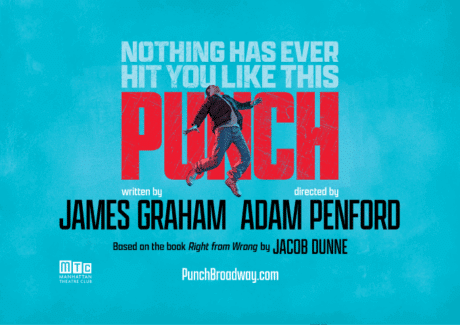
Following critically acclaimed sold-out runs in London, Punch, adapted by two-time Olivier Award-winning playwright James Graham from the autobiographical book Right from Wrong by Jacob Dunne, is now making its American debut with MTC in a limited engagement at Broadway’s Samuel J. Friedman Theatre, in association with England’s Nottingham Playhouse. Directed by Nottingham’s Artistic Director Adam Penford, the powerful emotional drama, inspired by the true story of the death of paramedic James Hodgkinson, the victim of a fatal one-punch to whom the production is dedicated, considers the sequence of actions, consequences, forgiveness, and salvation experienced by Jacob, the young man who killed him.
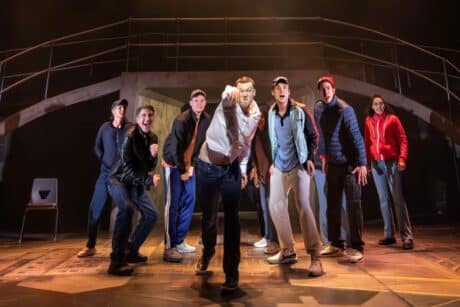
The narrative weaves back and forth in time, as the protagonist – a working-class kid from a broken family living in The Meadows, a public housing development in Nottingham – recounts his personal story in direct address to the audience, with re-enacted memories of the dramatic episodes that defined his journey. After being diagnosed with dyslexia, ADHD, and autism, the young Jacob decides “not to even try anymore” and turns to life in a gang, to feel invincible, to have a sense of belonging, and to gain the respect of his mates by being their hardest fighter and most loyal defender. But in 2011, when one of their many pub-hopping nights of drinking, dancing, and drugs fuels their itching for some action (“A fight’s coming tonight”), it results in Jacob landing an unprovoked deadly punch on a random stranger outside and landing himself in prison after being turned in by Raf (another member of his gang), convicted of manslaughter in a court hearing, sentenced to 30 months of incarceration, and transferred to a youth offender institute, where he counts down the time.
Upon his release after fourteen months, he finds himself homeless, unemployed, isolated from his family, and welcomed back by his gang. But he’s had time to reassess his past and to consider his future, as he comes to think about the human cost of what he did, to accept the guilt, shame, responsibility for, and consequences of his actions, and to turn his life around. He does it with the help of a support group and a structured Restorative Justice program, arranged and assisted by his probation officer Wendy and charity worker Nicola, through which he agrees to have contact with James’s grieving parents, Joan and David, at first by way of letters and then in a face-to-face meeting, to give them answers to the questions they’ve struggled with and the healing they need. With their encouragement, Joan’s forgiveness, and David’s respect, he finds salvation through them and a new purpose in life, returning to school, earning a college degree in Criminology, and joining together with them in TED talks to share their story and to help others avoid the hopelessness he experienced, the criminality he embraced, and the lethal mistakes he made.
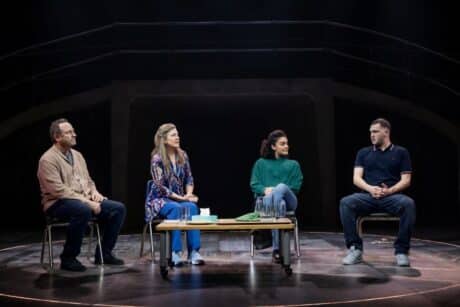
Will Harrison turns in a fully rounded, deeply expressive, visceral portrayal of Jacob in a spot-on English dialect (coaching by Ben Furey and Charlotte Fleck), recounting the joys of his childhood, the challenges of his youth, the wild highs of his rebellious recklessness, and the cathartic effect of his crime, shifting from shocked realization and panic over what he’s done to remorse (the scene of his first encounter with Joan and David is a tear-jerker, as he’s unable to make eye contact with them and can barely find the words to speak), rehabilitation and redemption (gratefully crediting them with saving his life), and social outreach (in an attempt to try to save others).
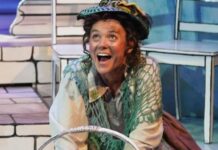
The rest of the company appears in multiple roles as his family, friends, gang members, partyers, medical and correctional staff and facilitators, with standout featured performances by the always outstanding Victoria Clark as Joan, delivering her heartbreak and anguish, growing understanding and empathy, and desire to honor the compassionate character of her son by reaching out to Jacob, and doubling as his hobbling grandmother Nan, espousing the “Victorian Values” of hard work, just rewards, and community, and bringing the laughs, while embodying each with a distinctive personality and masterful English accent; Sam Robards as both David and Raf’s Dad – polar opposites in social class, dress, speech, and bearing, and barely recognizable as the same actor; and Lucy Taylor as Jacob’s Mum and Wendy, in skillfully understated portrayals that capture the essence of both women. Rounding out the cast are Camila Canó-Flaviá as Nicola and Clare (a local girl Jacob meets, who becomes a nurse, reconnects with him, and ultimately marries him and has a son); Cody Kostro as the snitch Raf and Jacob’s estranged younger brother Sam, invited by Jacob (to whom he comes out) to live with him after the death of their mother; Piter Marek as his professor Derek, Tony, who tells him the route to take to evade being captured after the one-punch, and Detective Sergeant Villiers, who questions him; and ensemble members Kim Fischer, Jacob Orr, and Amber Reauchean Williams.
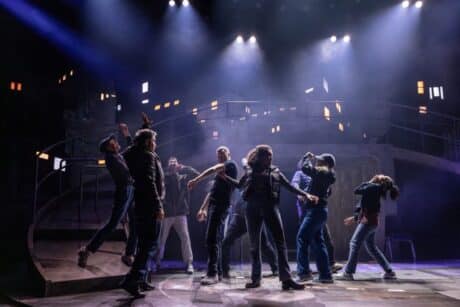
A stark stationary set (by Anna Fleischle) of the curving Trent Bridge over the River Trent and its concrete underpass below, with a background cityscape of the old buildings of Nottingham, transports us to the city (the legendary home of Robin Hood, humorously referenced in the script) and easily transitions to the prison and other locales with movable chairs and table, and doors that open and close at the back of the tunnel for the indoor scenes. Original music and sound (by Alexandra Faye Braithwaite) sets the changing tones, with evocative lighting (by Robbie Butler) that shifts from shining a spotlight on Jacob, to brightening for the conversations with Joan, Dave, and the counselors, to the darker atmosphere of the fight sequences and the pubs, with colored lights for the drugged-out group dances (stylized movement direction by Leanne Pinder), and costumes (also by Fleischle) that visually define the characters, their ages, and their stations in life.
If Punch were not a true account of the devastation, recovery, and outreach of real-life people, it would require a stretch of the imagination to believe the story of their increasingly compassionate evolution, reconciliation, and mutual support. It’s a profoundly affecting example of the goodness of humanity that can come from the worst possible pain, with fully empathetic performances that deliver the message of hope for everyone, a call for social rehabilitation for those who need it, and the impact of restorative justice to make it happen.
Running Time: Approximately two hours and 15 minutes, including an intermission.
Punch plays through Sunday, November 2, 2025, at MTC, performing at the Samuel J. Friedman Theatre, 261 West 47th Street, NYC. For tickets (priced at $94-225.50, including fees), go online, or find discount tickets at TodayTix.