Shakespeare would love it. And audiences will too, once they cotton to the fact that gender, in Mei Ann Teo’s new take on Twelfth Night, is rarely static. In fact, male and female roles — as revealed in the Folger’s new production, directed by Teo — are as interchangeable as a costume or hat.
Call it cross-dressing or mistaken identity, gender confusion has long been a source of comedy. It’s a plot device dating back to the Romans, then stretched to extravagant heights by the Bard nearly two millennia later. Under Teo’s direction, the plot device yields a darker, funnier tale.
“How is Twelfth Night different from Shakespeare’s other plays about mistaken identity?” I asked, as we settled in for a chat on Zoom, prior to the play’s opening here in DC.

“While it’s true that Shakespeare wrote about gender fluidity in other plays,” Teo replied, “it’s especially beautiful in Twelfth Night. And that’s because the play itself is all about the slips and slides of desire.”
In Shakespeare’s time, Teo pointed out, all the roles were played by male actors. As a result, the jokes — and the innuendo — came straight out of the performance.
“However, the subversive nature of desire lies deep within the play itself,” Teo said, adding that the word queer, as applied to the play, is not just a sexual orientation. It’s a way of living with resilience and acting in direct opposition to oppressive structures, such as patriarchy. And it’s about challenging the norms in a celebratory way.
“Twelfth Night is actually the last day of Christmas,” Teo explained. “In many cultures, it’s celebrated as a type of carnival or revelry. It’s an accepted practice, on Twelfth Night, to revel in feelings or actions that might not be acceptable in normal society, but that make us human.
“And what a beautiful thing that we can do that in the theater!” Teo rejoiced, describing the act of performing or even seeing a play as a form of permission to do, or pretend to do, all the things that we might not be brave enough to do in real life, either because we don’t know how to do them, or because of the way in which we have been conditioned. “It’s a chance to go wild and let the conditioning go.”
“To go wild is actually the most beautiful thing the theater can do. Theater is, in its own way, a carnival,” Teo added. “A chance to wear masks, and then take them off. But the question of who is under the mask is much more complex.”
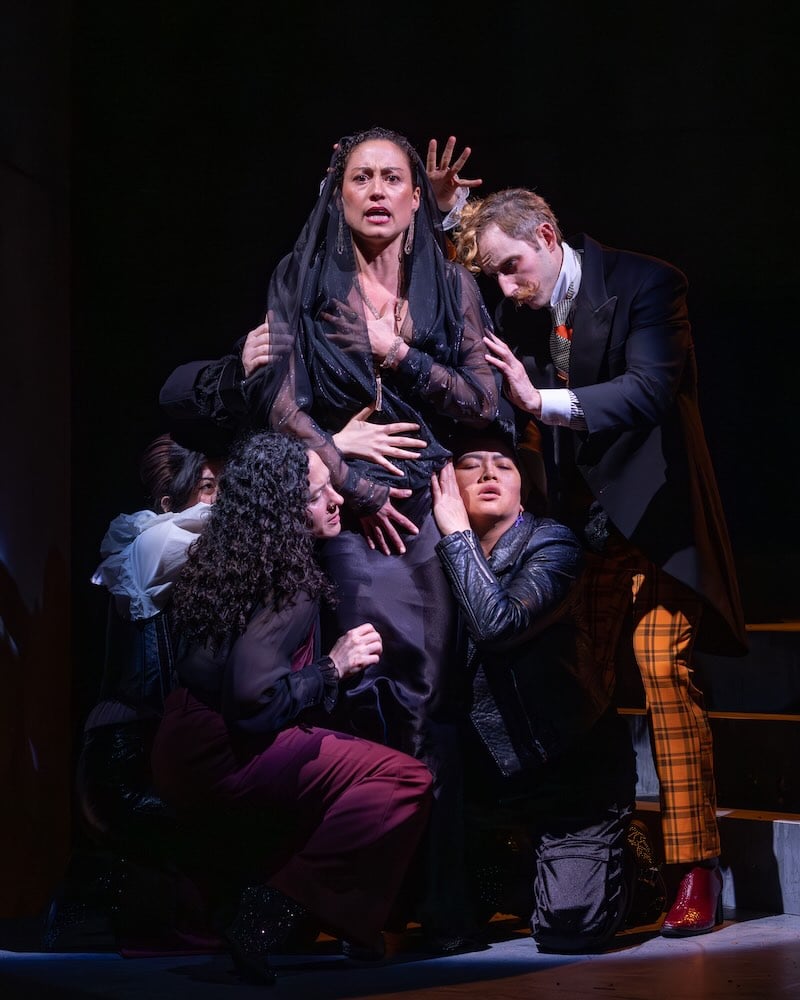
Teo described a revelation that came after rehearsals one day. “I realized that the word that’s most often used in this play is mad. Characters are constantly asking, ‘What is this madness?’ And what is this madness most related to? It’s the feeling of falling in love.
“As we fall in love,” Teo continued, “we feel like we’re losing our grip on rational thinking. I hope that every human being on earth gets to experience falling in love, no matter what form it takes. It can be eros, or the love of a parent. In fact, parents talk about the way that they love a newborn child as beyond anything they’ve experienced. So I’m not limiting this to erotic love, although the play does have a lot to say about that. But the play also includes platonic love. And it’s love that shakes us out of our masks.”
Certainly, the casting of this love-oriented Twelfth Night is reflective of Teo’s directorial spin. There is no particular rule about gender. Some of the male roles
are played by women, and some are not. Either way, gender doesn’t always matter.
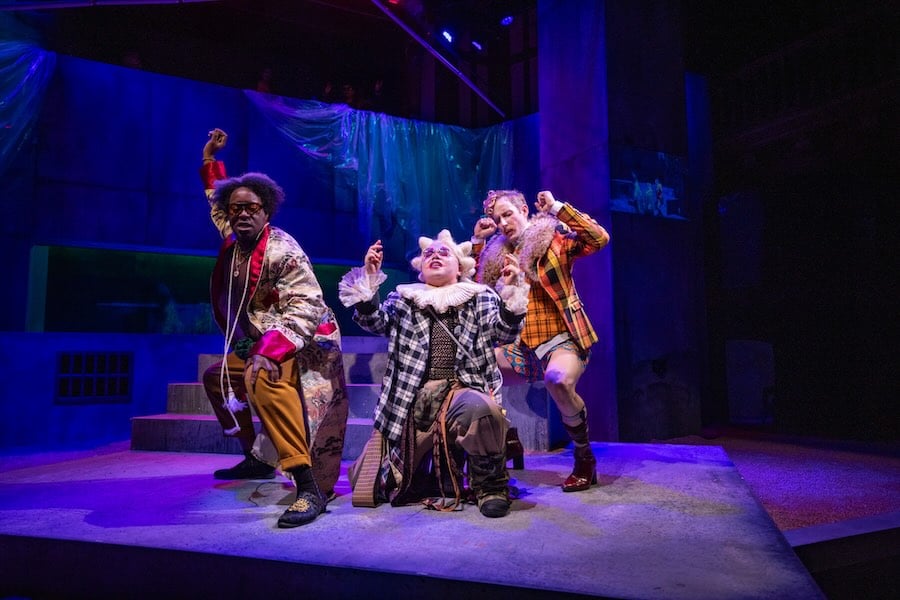
“I wanted every combination of falling in love,” Teo said. The director also wanted to expose the flip side of love — the hurt and jealousy and betrayals. For example, one of the least talked-about betrayals in the play is that of Sir Toby toward Sir Andrew. “The audience loves these clowns. But in the end, one betrays the other, and they go their separate ways.”
So the play is about all the layers of love, and about all the ways in which love goes beyond gender. It’s about the complexity of love. And Teo, as director, is committed to looking at all the different combinations.
Interestingly, the Folger production is quite a turnabout from the last time Teo directed Twelfth Night, which was about 20 years ago, right after Teo had graduated from Pacific Union College in Angwin, California. It was an outdoor, site-specific event, and Teo’s interpretation was completely different.
At the time of that earlier production, Teo had just graduated from college. Although Teo’s degree was in finance, Teo had already excelled in undergraduate theater productions. The college wanted Teo to stay on, but didn’t know what to call Teo, who was neither an intern nor an assistant professor. Teo suggested “resident artist,” and that stuck. Teo signed on to direct two shows a year, teach a class, and go on to summer training stints with major organizations, including the SITI Company in New York (Anne Bogart, who headed the group, subsequently became Teo’s mentor at Columbia). Teo also studied with Dijana Milosevic at the Dah Teater in Belgrade.
But why the finance degree, I asked, finding it an odd juxtaposition.
“Yes,” Teo laughed, “it is odd. But my parents were Singaporean Chinese, and I wanted to be a good Chinese child. My sister went into finance, so I thought I should too. So I got my finance degree, but never used it until years later, when I applied for a position in artistic leadership at the Musical Theatre Factory in New York. The board, in the middle of the hiring process, got very excited about my knowing finance. I called my mom when I left the interview, and when I told her how much they loved that fact, she said, ‘You have me to thank!’ ”
Of course, understanding finance was a great help in knowing how to budget a theatrical production. But it also helped Teo to understand what Teo couldn’t do, in terms of a career.
“There was a watershed moment when I was a senior looking for accounting internships. I suddenly had this visceral feeling that accounting was not for me. That was 24 years ago. And since then, I’ve done nothing but theater. I’ve done it as a professor, as a director, and as an artistic leader, currently at Ping Chong and Company in New York. But I’m living out my wildest dream, right now.”
Surprisingly, Teo has not done any other Shakespearean plays. Teo comes from a devised theater and new work background, specifically working with people who tell their own stories.
Last year, Tep directed the Folger’s production of Where We Belong by Madeline Sayet. Teo has also directed a lot of classics, including Sam Shepard’s True West, which Teo reinvented with an all-Asian cast. But Teo identifies essentially as a “new work” director.
“My approach to Twelfth Night is to treat it as a new play, and really think about the people in the room. I like inviting incredible artists to be a part of what I’m doing,” Teo said.
“At auditions, I ask the actors to choose any text in the play that they really care about. I tell them, ‘It doesn’t matter if you want to be cast in that role, or if you think you might be cast in it. Just any text you care about. And then pick a scene that can’t be done by one person.’ It’s amazing to see how many actors bring their artistry to bear. I get to see who they are, not just as actors playing a role, but as artists who are thinking about how performance can communicate more than the text.”
For example, “There’s a moment when Olivia has been grieving for her brother for seven years, and everyone’s tired of it, including Sir Toby. He says, ‘What a plague means my niece to take the death of her brother thus?’ And then things begin to change.
“We see it during Olivia’s first meeting with Cesario, when she starts to feel her body again. She’s like a statue at first, but then her blood starts pumping through her veins, and what is usually a monologue is activated by the group, embodying what it feels like to feel alive again.”
Teo quoted Candy Darling — the superstar of Andy Warhol’s realm — who famously said, “I’m a thousand different people. Everyone is real.”
“We’re not just one thought; we’re many thoughts,” Teo said. “All the complexity of each moment is present. So the question is, how do we bring that complexity to performing this play, which already has so much complexity written into it? And how do we physicalize that?”
With choreography, I guessed, suspecting that Tony Thomas, last seen at the Folger in Mary Zimmerman’s Metamorphoses, had once again cast his spell!
“Of course,” Teo agreed, pointing out that Thomas has added layers of meaning to the world of Twelfth Night. “For example, there’s an opening moment in which Viola has washed up on the seashore, and there is movement that feels like waves lapping over the bodies, and it’s so delicate that it suggests the possibility of both death and survival.”
Thomas is not the only DC artist in this production of Twelfth Night, Teo continued. “Alyssa Keegan, who plays Orsino, was one of those who helped me to understand how to do the play. Todd Scofield is amazing as Antonio; he could fall in love with a rock, and I would believe it. Alina Collins Maldonado is an incredible Olivia. And Lilli Hokama, as Viola/Cesario, has been a tremendous soul, joining me on this journey. I know people will come away thinking, ‘Wow, those actors are Olympians of the mind, heart and spirit.’”
Bottom line, What should audiences expect?
“I think they can look forward to a really hilarious and sexy time, remembering what it’s like to fall in love and maybe feeling brave enough to do it again.”

Running Time: Two hours and 15 minutes, including one 15-minute intermission.
Twelfth Night plays through June 22, 2025, at the Folger Theatre, 201 E Capitol Street SE, Washington, DC. To purchase tickets ($20–$84, with many discounts available), go online, call the Box Office at (202) 544-7077, or visit TodayTix.
To see credits for the cast and creative team, click here.
COVID Safety: While Folger audiences and employees are no longer required to wear masks at most events, masks are welcome and remain an important preventive measure against COVID-19. Anyone needing or choosing to wear one is encouraged to do so. Folger’s current safety protocols are here.
SEE ALSO:
Folger Theatre announces cast and creative team for ‘Twelfth Night’ (news story, April 17, 2025)