Uncle Vanya, directed by Simon Godwin, and co-produced by STC and the Berkeley Repertory Company, is an indispensable production. The author is Anton Chekhov, the Russian literary genius who died at the tragically early age of 44. It is the story of one of those unanticipated shocks that can rip a family apart. In the hands of Godwin’s incandescent cast, it is sometimes poignant, sometimes frightening, sometimes irresistibly comic. Vanya is the perfect play for our Alice in Wonderland era.
It is 1900. Retired professor Aleksándr Serébryakov (Tom Nelis) and his second wife, the beautiful (and much younger) Eléna Andréevna (Ito Aghayere), have come to their family’s run-down country estate. They have been living off its earnings.
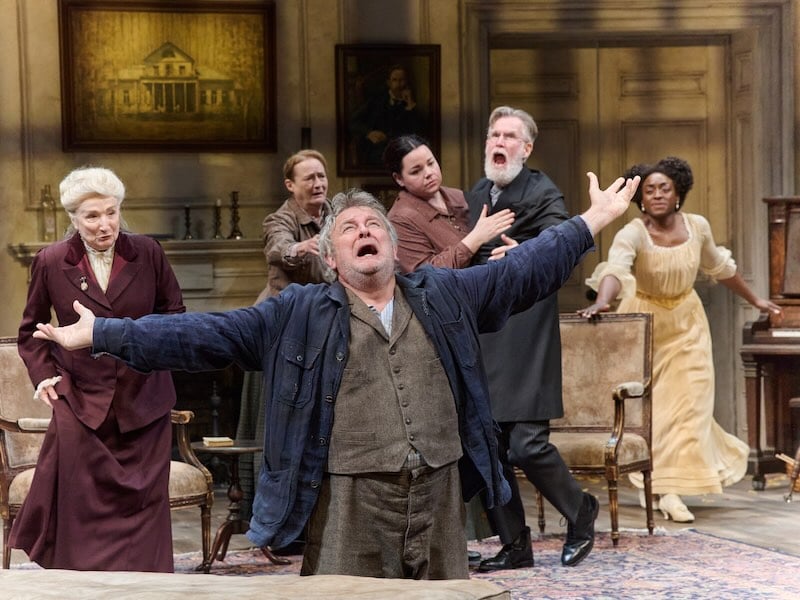
Uncle Vanya (Hugh Bonneville), whose late sister was Serébryakov’s wife, has been taking care of the property, with the help of his niece, Sófya “Sonya” Alexándrovna (Melanie Field). Sonya, 20, keeps calm and carries on. Vanya, 47, is on the brink of exhaustion.
The local doctor, Mikhaíl Ástrov (John Benjamin Hickey), visits frequently, partly due to Serébryakov’s demands for medical attention and partly due to Eléna’s mysterious allure. He is utterly worn out by work. Day and night, there is one bang on his door after another — here a typhus epidemic, there the death of a patient.
We first see Ástrov in a rare moment of happiness, being comforted by the family’s elderly nanny, Marína “Nana” Timoféevna, played by DC favorite Nancy Robinette. Her warmth and acceptance disarm him, and she reminds him of the Nana of his childhood. “Give me long, deep hugs,” he says. “I used to feel like nothing could harm me.”
Hickey’s Ástrov is a compelling figure: a man in constant crisis, fighting, succeeding, failing. Chekhov, a doctor himself, put much of himself into the character. Robinette as Nana is sometimes playful, sometimes indignant, but always a source of hope for those who can no longer go on. Her kindness is called upon frequently.
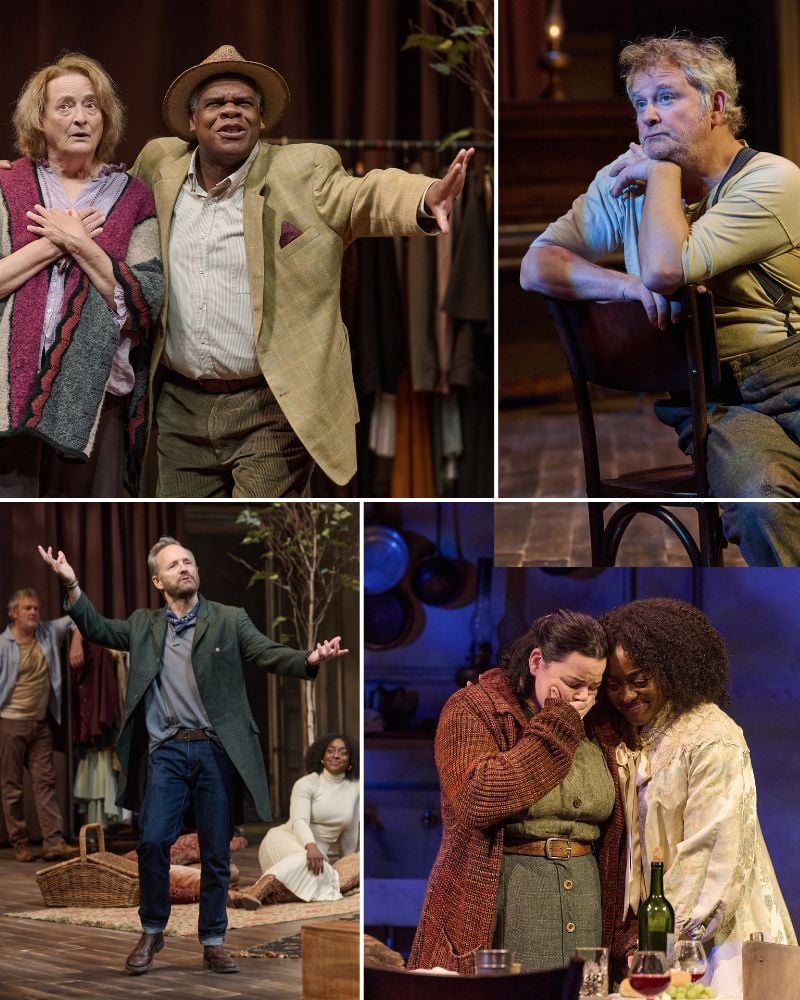
Serébryakov considers himself a literary virtuoso, one of Russia’s intellectual vanguard. Although famous, he is apparently unaware that (at least according to Vanya) his work is of no interest. He is also something of a hypochondriac who expects to be waited on. Uncle Vanya is not amused. When he asks for tea to be sent up to his room, after going on a walk and ignoring it for two hours, Vanya has had enough:
VANYA: Anything else? Any other refreshments? A bowl of fruit? A new pair of slippers? Something from the village perhaps? I mean Nana is here — she’s got nothing better to do. She could walk into town.
SERÉBRYAKOV: I said just tea.
Hugh Bonneville’s performance is breathtaking — replete with variety, vividly and painfully real. His Vanya is the kind of man who excels at witty, occasionally bitter monologues, secure in the knowledge that everyone will listen to him. Although he often seems motivated by fury, he is in love with Eléna, and his attempts to charm her have an adolescent appeal. He is always moving — dancing, flirting, seeking mercy from the heavens, taking Eléna’s hand and hoping for more. He knows his ire at Serébryakov is partly due to jealousy. But when the Professor suggests a plan for the estate that enrages him, he cannot stop himself:
VANYA: You lecture everybody about art and politics and life and people but you don’t have the faintest understanding of art or real people or the way real people think and feel and need to be loved! All those essays of yours that I struggled to get through, thinking I was stupid because I couldn’t make head or tail of them, I realize now you’ve been having us all on!
The love affairs, as often with Chekhov, are complicated. Ástrov and Vanya are both in love with Eléna. Sonya is in love with Ástrov. Eléna is drawn to Ástrov but attempts to resist him.
Ito Aghayere’s Eléna is lovely, and her interpretation of the role has subtlety and depth. When she is chastised for “doing nothing,” she responds with dignity. She is spirited — at one point she tells Vanya to shut up — and, like the others, she is not particularly happy. The men especially can’t see past her beauty, and their advances often annoy her. But she handles it all with grace.
ELÉNA: Huh, Uncle Vanya. Says I have a mermaid’s blood in my veins. Let yourself go for once in your life! Maybe I should. Fly away from all these sleepy faces. And forget I was ever here. Of course, I’m far too much of a coward for that. The doctor comes here every day now. I know why he comes. I should have fallen to my knees in front of Sonya and begged her forgiveness… I know why he comes. Sad roses. Autumn roses.
Melanie Field as Sonya makes the most of her every moment. She is always working. Her longtime love for Ástrov has led nowhere. She is clever, industrious, and a good person, but moored in isolation. One is reminded of the girls in Chekhov’s hometown, Taganrog. The boys went off to higher education. The girls married whoever was still around. One can speculate that had Sonya lived in a less narrow-minded time, or been able to go to college, she would have found a nice husband and forgotten all about Ástrov.
Craig Wallace, one of DC’s favorite actors, is Ílya Ílyich Telégin or “Waffles,” a prizhivalshchik. This was a relative or family friend given refuge and support, a familiar figure in Russian households of the time. His indignation when Eléna cannot remember his name, and his fidelity to his extremely estranged wife are particular highlights of a deliciously comic performance.
As Serébryakov, Tom Nelis is the perfect picture of the self-deluded “great man.” Ultimately, he arranges a family meeting with explosive results. As far as he is concerned, Vanya’s unhappiness is not his problem but the result of Vanya’s own choices. He will do whatever it takes to maintain his exalted self-image. He may betray his family, but he will never admit it to himself.
Sharon Lockwood as Maríya Voinítskaya, Vanya’s mother, idolizes Serébryakov but has little sympathy for her son. She tells him bluntly that he has failed because he’s never done anything. At times, she loses touch with reality and is comforted by, who else, Nana. The collective spirit of the cast is palpable, as well as their individual distinction. Ensemble and fight captain is Kina Kantor.
Simon Godwin’s direction achieves excellence in every respect — visual, emotional, and stylistic. Conor McPherson’s translation is notable for its suppleness and modernity.
Scenic design by Robert Brill is highly detailed, extremely sophisticated, and exceptionally versatile. At different times, there are pillows (which can be thrown) and a piano, which Eléna will play. The handsome period costumes are by Susan Hilferty and Heather C. Freedman. Jen Schriever’s lighting design enhances each changing mood of the production. Sound designer Darron L. West brings the sounds of nature — birds, rain, and thunder, and the haunting music of strings.
The tone of the play can be summed up in one telling incident.
Vanya and Ástrov, both drinkers, are friends. As men sometimes do, Ástrov tries to cheer his friend up with an insult.
ASTROV: Don’t flatter yourself. No one thinks you’re mad. Everybody just thinks you’re an idiot. One who’s been fatally starved of love. In other words, you’re completely normal.
This wildly enjoyable Uncle Vanya is a tribute to the value of art in an unsettled time. Don’t miss it.
Running Time: Approximately two hours and 30 minutes, with one 15-minute intermission
Uncle Vanya plays through April 20, 2025, presented by Shakespeare Theatre Company, in association with Berkeley Repertory Theatre, at Harman Hall, 610 F Street NW, Washington, DC. Tickets (starting at $35) are available at the box office, online, or by calling (202) 547-1122. Shakespeare Theatre Company offers discounts for military servicepeople, first responders, senior citizens, young people, and neighbors, as well as rush tickets. Contact the Box Office or visit Shakespearetheatre.org/tickets-and-events/special-offers/for more information. Audio-described and captioned performances are also available.
The Asides program for Uncle Vanya is online here.
COVID Safety: All performances are mask recommended. Read more about STC’s Health and Safety policies here.
Uncle Vanya by Anton Chekhov
Adapted by Conor McPherson
Directed by Simon Godwin
Produced in association with Berkeley Repertory Theatre
CAST
Eléna Andréevna (Yelena): Ito Aghayere*
Iván Voinítsky (Vanya): Hugh Bonneville*
Sófya Aleksándrovna (Sonya): Melanie Field*
Mikhaíl Ástrov: John Benjamin Hickey*
Ensemble, u/s Eléna Andréevna, u/s Sófya Aleksándrovna: Kina Kantor*
Marína Timoféevna (Nana): Nancy Robinette*
Maríya Voinítskaya (Grandmaman): Sharon Lockwood*
Aleksándr Serébryakov (Alexandre): Tom Nelis*
Ílya Ílyich Telégin (Waffles): Craig Wallace*
u/s Maríya Voinítskaya, u/s Marína Timoféevna: Anne Darragh*
u/s Iván Voinítsky, u/s Mikhaíl Ástrov, u/s Ensemble: James Whalen*
u/s Aleksándr Serébryakov, u/s Ílya Ílyich Telégin: John Leslie Wolfe*
ARTISTIC TEAM
Scenic Designer: Robert Brill
Costume Designer: Susan Hilferty, Heather Freedman
Lighting Designer: Jen Schriever
Sound Designer: Darron L West
Wig Designer: Satellite Wigs, Inc.
Fight and Intimacy Consultant: Danielle O’Dea
Additional Fight Choreography: Robb Hunter
Dramaturg: Drew Lichtenberg
Casting: Danica Rodriguez, Karina Fox
Production Stage Manager: Elisa Guthertz*
Assistant Stage Manager: Leigh Robinette*
Production Assistant: Trinity Wicklund
Co-Producer: Berkeley Repertory Theatre
* Member of Actors’ Equity Association, the Union of Professional Actors and Stage Managers.
SEE ALSO:
Shakespeare Theatre Company announces cast of ‘Uncle Vanya’ (news story, March 9, 2025)